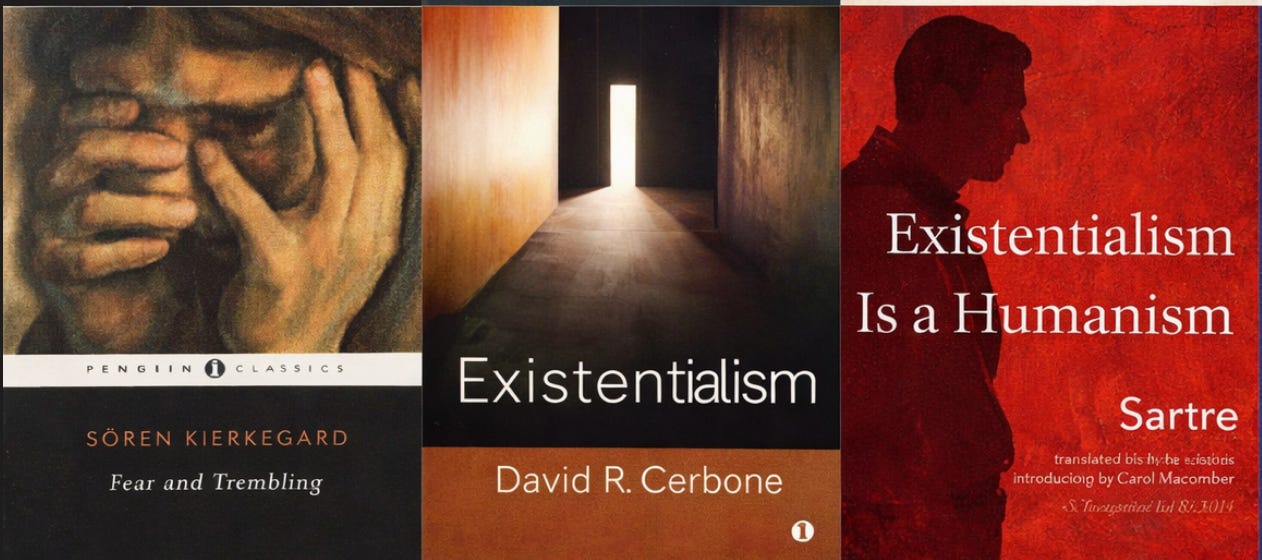
On Existentialism
Each choice does not merely express who I am, it creates who I am.

There are ideas everyone ought to encounter. Books one ought to read. Sentences that make you say, Where have you been all my life? Music you’ve never heard, films you’ve never seen. Sartre was such a writer for me.
It was a book I opened on a cold winter day, listening to the wind simply because I couldn’t find anything better to listen to. I had tried to read it in high school and failed to understand it. What on earth is this man saying? What is he talking about? What am I supposed to learn from him? Is there any point in learning it at all? If it will be forgotten anyway, should one never begin? If you already know the ending, should you still act? Give me a reason to act, my God.
I don’t know about you, but I approach every novel with the same question: What can this add to me? Every book should help crack the shells I’m trapped in, help me transcend myself. Otherwise, why read it at all?
I’ve underlined the following sentence countless times:
“Three o’clock is always too late or too early for anything you want to do.”
Doesn’t most of what you want to begin in life feel exactly like this? As if you’re already too old or late? As if the best time to start was two or three years ago.
That line “Three o’clock is always too late or too early…” isn’t a witty observation. It’s a description of how postponement feels from the inside. The mind manufactures a perpetual wrongness of timing: too late to start, too early to be taken seriously. And because both cannot be true at once, the feeling hides its real function. Its function is to keep you safe from the exposure of choosing. If you never begin, you never risk seeing what you are capable of. You can preserve the fantasy of potential indefinitely. Sartre’s cruelty is that he does not let potential count as a category. For him, the self is not what you could be. It is what you do, under imperfect conditions, with the clock already running.
Looking back at the book, I wanted to see what I had actually learned from it. Let’s take a look at the notes worth taking from the masters.
I didn’t come to Sartre for “philosophy.” I came because I couldn’t move. Not physically but existentially. I was stuck in the familiar trap: the sense that the best time to act has already passed, that any beginning now will look like imitation, compensation, or late repentance. Sartre’s value is not that he comforts you. It’s that he refuses to. He takes the most common excuse - I’m not ready yet, it’s not the right time, the conditions aren’t right - and treats it as what it often is: a sophisticated way of avoiding responsibility. In that sense, Sartre doesn’t teach you how to live. He corners you into the fact that you already are.
ATTENTION : This post will be notes, highlights and screenshots along my existentialist journey. and going to be a loooooooong post. Brace yourself for impact guys. This post is likely to be edited along the way. This fact may be the core theme of the post as well, to be edited and changed, endlessly.
EXISTENTIALISM
Where does the term existentialism come from? The name itself was actually coined by Marcel. But even before him, it is possible to see the seeds of the concept in Karl Jaspers and Martin Heidegger. Heidegger, for instance, says: “Our essence lies in our existence.” So we may say Sartre stole some ideas from Heidegger, but who are we to blame him, heh?
Modern philosophy took shape as a reaction to two decisive shifts: the rise of modern science during the Scientific Revolution of the sixteenth and seventeenth centuries, and the breakdown of religious unity brought about by the Protestant Reformation in the sixteenth century. United we may have risen with the help of religion and God but the idea started to dissolve. “I” suddenly started becoming more and more important than “we” as believers and society.
Of course, no philosophical movement can be understood apart from the historical context in which it emerged. If we go further back, we see that figures like Galileo and Newton, Copernicus and Kepler, posed serious challenges to traditional religious ideas.
Galileo effectively removed us from the center of the universe. What, then, did the dominant Christianity in Europe promise? That the Earth stood at the center of the cosmos. That heaven revolved around the Earth. That God had placed the world at the very heart of everything He created.
Galileo showed us instead that we are not at the center of an infinite universe that everything revolves around the Sun. And even if God did have a plan for us, we now knew with certainty that we were no longer at the center of it.
What are we to do if we are not the center of God’s plans? What if there is no plan at all?
WARS CHANGE MEANING
When we look at the early twentieth century, we encounter two major wars. Existentialism was shaped by a range of forces, including the two World Wars and the political and social upheavals that followed them. After the First World War, many people began to question traditional values and beliefs; the devastation wrought by the Second World War only deepened this sense of uncertainty and disillusionment.
These events inevitably produced an existential crisis, as people struggled to find meaning and purpose in a world that appeared chaotic and devoid of sense. What, after all, are we doing here? With all the madness around, is it really necessary to live?
Existentialism started with concerns of Kierkegaard, Schopenhauer and Nietzsche and then expanded by other figures.
The concerns of Kierkegaard, Schopenhauer and Nietzsche were taken up during the first half of the twentieth century by Karl Jaspers in his existence philosophy, and by Martin Heidegger, Jean-Paul Sartre, Simone de Beauvoir, Maurice Merleau-Ponty and Albert Camus. The last four in this list all knew each other and hung out together in Parisian cafés in the 1930s and ‘40s, chain-smoking and discussing the enormous books they were working on. Imagine being at the next table, trying to enjoy your coffee, while Sartre and Camus argue about whether suicide is a legitimate response to the absurd. Or overhearing de Beauvoir explain to Merleau-Ponty why the body isn’t just meat we’re trapped in. These weren’t dusty academics - these were people who stayed up too late, drank too much coffee, probably annoyed the café owners, and somehow, between cigarettes, created the philosophical framework that would define modern anxiety. They were us, essentially. Overthinking everything in cafés, except they had the discipline to turn it into thousand-page books.
The real roots of existentialism can go back to the first humans:
Existentialism is in fact only a branch or a development of a philosophical theory called phenomenology, which Edmund Husserl formulated around 1900 as a kind of philosophical hygiene, a way to clean thought of its accumulated abstractions and return to lived experience. Husserl wanted to describe consciousness as it actually works, not as we theorize it should. His slogan was “back to the things themselves.” But this impulse to examine experience directly had been building for centuries. Hegel, in works so difficult they require secondary literature just to approach, tried to map the entire development of consciousness through history, from the simplest sense-certainty to absolute knowing, a journey he believed paralleled both individual development and human civilization. Before Hegel, Immanuel Kant had already performed what he called a “Copernican Revolution,” showing that we don’t passively receive knowledge from the world but actively structure it through innate categories of understanding. Space and time aren’t “out there,” Kant argued; they’re the necessary forms through which we experience anything at all. This realization came to him through reading David Hume, who had demonstrated with ruthless clarity that causation, the self, the external world, all the furniture of traditional philosophy, couldn’t be proven from experience alone. They were assumptions we make, useful fictions we can’t live without but can’t justify. Each thinker dismantled a piece of the previous generation’s certainties.
And so it goes, back down the foggy ruins of time, through Descartes huddled by his stove in 1619, doubting everything except the fact that he was doubting. Through Thomas Aquinas in 13th century Paris, trying to reconcile Aristotle with Christianity, faith with reason, revelation with logic. Through the Islamic philosophers, Al-Ghazali and Averroes, who preserved and commented on Greek philosophy while Europe stumbled through the Dark Ages. Through Augustine in the 4th century, confessing his sins and wrestling with free will, asking how we can be responsible if God knows everything in advance. Through the Neoplatonist Plotinus, teaching in 3rd century Rome that reality emanates from an ineffable One, and that the soul’s task is to ascend back toward it. Through the Stoics, Marcus Aurelius writing his meditations in a military tent, Epictetus teaching that we control nothing except our own judgments, that freedom lies in accepting what we cannot change. Through Aristotle, who cataloged everything that exists and declared that the unexamined life is not worth living, wait, that was his teacher. Through Socrates, wandering the streets of Athens in the 5th century BCE, interrogating everyone, claiming to know nothing except his own ignorance, annoying people so thoroughly they sentenced him to death. Through Heraclitus, who said you can’t step in the same river twice, that everything flows, that war is the father of all things. Through Parmenides, who argued the opposite, that change is impossible, that Being simply is and cannot not be.
And further back still, to the first prehistoric cave person with a half-decent meal inside her who, finding she was not about to be devoured by wolves, looked up at the stars or down into a chasm and asked herself, what is the meaning of death, the universe and nothingness? Philosophy is just that question, asked again and again, in different languages, under different stars, by people who can’t stop asking it.
The existentialists didn’t invent the anxiety. They just stopped pretending it could be solved.
Existence precedes essence.
To understand what Sartre means by “existence precedes essence,” let’s begin by slowing down and examining each word on its own. It is a boring task but sum is greater than all of its parts.
What is essence? Frankly, that question exceeds me. But in a general sense, we can think of essence as what a thing is, its defining nature, its supposed core. For example I prefer to define myself as kind and humanist. These are what makes me “me”. Philosophers seem to have diverge opinion about essence. When they try to explain essence, they usually mean the set of characteristics that determine something in advance : what it is meant to be. As Sartre puts it, essence is the concept or blueprint that comes before the object itself.
What matters is that we agree on this point: essence refers to a pre-given definition, a fixed nature, a purpose decided in advance.
Now contrast this with existence. Existence simply means that something is there, that it appears in the world, that it lives, acts, and unfolds in time.
When Sartre says existence precedes essence, he is making a radical claim about human beings. Unlike objects, we are not born with a predefined nature or purpose. We first exist, we find ourselves thrown into the world and only afterward define who we are through our choices, actions, and commitments. There is no script written beforehand.
In short, we are not something before we act. We become something by acting. So, to act is to become.
Sartre clarifies the idea of precedence with a simple example: a paper knife. The example may feel dated, but the point applies to any human-made tool.
A paper knife is deliberately designed and made for a specific purpose. Before it exists, it already has a plan, a function, a definition. That plan is its essence. In this sense, essence comes before existence, not only in time, but in explanation. The object exists because it was first conceived.
If we ask why a paper knife exists at all, the answer is not found in its material alone, but in the idea behind it. Someone imagined it, designed it, and then brought it into being. Its existence is explained by its essence.
This is precisely the structure Sartre will later deny for human beings.
To say that, in the case of human beings, existence precedes essence is to say this: nothing has been prepared on us in advance. There is no answer waiting in a drawer to the question of who we are. We arrive without a definition and spend our lives producing one, inconsistently, often without noticing and never completing.
Each of us is nothing more, and nothing less, than the accumulation of our choices, our actions, the situations we find ourselves trapped in or responsible for. And since this accumulation is always in progress, always unfinished, there can be no final description while we are still alive. The record remains open.
The irony is unsettling: there is no complete me until I am no longer here. Only when the movement stops does the shape become visible. So you cannot say who I was until I am dead. I am dead inside, does that count?
So the usual separation collapses. There is no hidden essence waiting to be discovered behind our existence. There is only the slow, bureaucratic labor of living itself - day after day - producing, without appeal, whatever it is we turn out to be.
We are condemned to be free.
For Jean-Paul Sartre, human freedom is anything but comforting, it is more disturbing than everything that can happen to us. When he says that we are “left alone and without excuse,” he is pointing to its darker side. We are condemned to be free because our freedom rests on something deeply paradoxical: we did not choose to be free in the first place. We did not choose to be here neither, so who are we going to blame?
We simply find ourselves thrown into a condition where we must choose - constantly, relentlessly - without ever having chosen to be the kind of beings who must choose. We were never given the option of being something unfree, like a lion in a cage or a tree. This makes our responsibility almost unbearable. Each of us, condemned to be free, carries the weight of the whole world on our shoulders. What if we failed? Everybody makes it except me. How am I going to deal with the unbearable heaviness of failure my colleagues have put on me?
This lack of determination reaches even into our own past decisions. Sartre sees subjectivity as a continual breaking-away from oneself. The past appears as something that is no longer; the future as something not yet. A decision made yesterday has no binding power today unless I choose to reaffirm it. It sits there like an inert object.
Sartre illustrates this with the gambler who once swore never to gamble again, yet finds himself drawn back to the table. In that moment, the gambler experiences a rupture in determinism. Nothing truly stands between him and his action, not his past promises, not his resolutions. There is only a fragile gap between who he was and who he now must choose to be.
Sartre’s “responsible for everything” is easy to misread as melodrama, as if he means you caused the world. He doesn’t. He means something sharper and more humiliating: you are responsible for what you make of what you did not choose. You didn’t choose your birth, your era, your body, your early wounds, your country, your starting advantages or deficits. But the moment you use those facts as an alibi therefore I couldn’t you shift from describing a constraint to inventing an excuse. Sartre’s claim is not that constraints don’t exist; it’s that they do not relieve you of authorship. You are answerable for the meaning you assign to your situation and the actions you take within it, even when the situation is unjust.Sartre’s “responsible for everything” is easy to misread as melodrama, as if he means you caused the world. He doesn’t. He means something sharper and more humiliating: you are responsible for what you make of what you did not choose. You didn’t choose your birth, your era, your body, your early wounds, your country, your starting advantages or deficits. But the moment you use those facts as an alibi therefore I couldn’t you shift from describing a constraint to inventing an excuse. Sartre’s claim is not that constraints don’t exist; it’s that they do not relieve you of authorship. You are answerable for the meaning you assign to your situation and the actions you take within it, even when the situation is unjust.
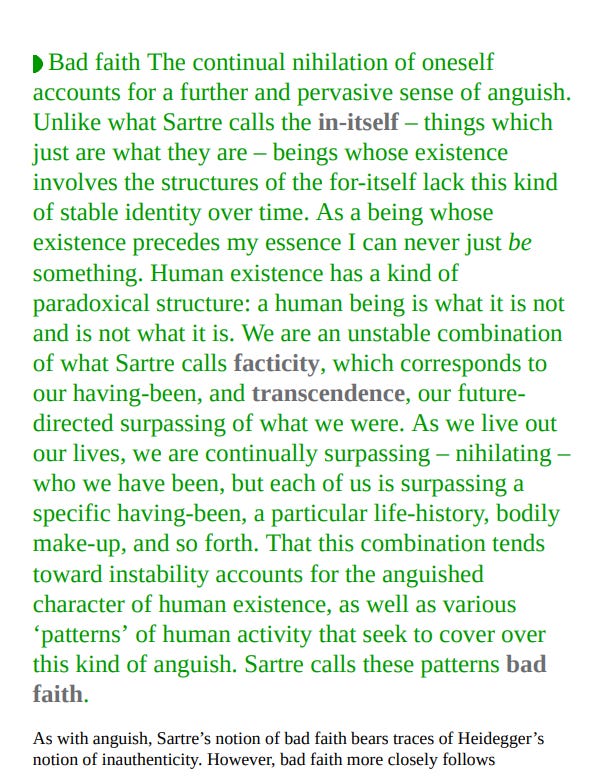
Bad faith
Sartre’s most familiar illustration of bad faith is the café waiter. Watching his exaggerated precision and attentiveness, Sartre suggests that the waiter is not simply being a waiter but performing one. The role becomes a kind of routine, almost a theatrical bit, and the person himself recedes from the scene. In a very real sense, he is absent from what he is doing. How do I know if am performing now? Am I being true to myself? What am I if I cease to act? What if there is no chance for me but act?
There is something faintly unsettling about interacting with someone so thoroughly absorbed in a role. You keep waiting to encounter the person behind the performance, but that moment never arrives. When I reflect this idea on me I realize that I take on my roles and performances. How do I strip myself of of these roles? I feel like these roles have become my identity. What am I when I destruct all identities?
When someone is performing so well, the conversation between you and her is not genuine exchange but the recitation of lines, predictable cues and responses. And gradually, you too begin to slip into character, responding with your own pre-scripted lines. This is where Sartre’s point sharpens: freedom is never purely individual. One person’s bad faith pulls others into its orbit. Is this the precursor to the line “hell is other people”? We shall see. These lines have to show this.
Seen this way, the waiter places himself out of reach. You do not speak to her; you speak to the waiter. At first glance, this might look like a form of control, distance as power. But the reality cuts the other way. He is the one who has reduced himself to a rigid pattern of behavior, surrendering to the expectations imposed by customers, employers, and the broader social script. He plays the part assigned to him, and in doing so, complies with a pressure that asks him to be nothing more and nothing other than the role he performs.
I recognized myself in that waiter more than I wanted to admit. In meetings, I noticed I would slip into a performance of competence - nodding at precise intervals, using phrases I had heard others use, matching my tone to what seemed expected. The performance was so smooth that I could sometimes complete entire conversations without actually being present for them. Afterward, I would have no memory of what was discussed, only a vague sense that I had “done well.” This is the trap of bad faith: it works. People respond to the performance. They nod back. The role is validated by others who are also performing their roles. We collaborate in each other’s absence. The real danger is not that bad faith fails, but that it succeeds so completely you forget you are doing it.
We are our choices.
To claim “we are our choices” is simply to draw the strict conclusion of existence precedes essence. There is no inner core, no fixed character, no hidden self behind our actions. What we are is nothing over and above what we do. We only exist, and are sum of our choices. Hope the choices are not zero-sum.
For Sartre, a person is not defined by intentions, feelings, talents, or past promises. Those things matter only insofar as they are acted upon. A coward is not someone who feels fear, but someone who flees. A generous person is not someone who values generosity, but someone who gives. Every choice is a self-definition.
This is why freedom is so heavy. Each choice does not merely express who I am it creates who I am. And because I choose in concrete situations, under real conditions, I cannot escape responsibility by appealing to my nature, my past, my psychology, or my circumstances. None of these choose for me.
In choosing myself, I also put forward an image of what a human being ought to be. That is why Sartre insists there are no innocent choices and no accidents. To choose is to legislate, first for myself, and indirectly for humanity.
So when Sartre says we are our choices, he means something ruthless:
there is no self hiding behind the act. The act is the self.
We are responsible for everything.
A frightening admission: I am responsible for everything. If God is dead, Sartre says, and you are spinning around on this round ball without ever having been asked for your consent, then you are responsible for what comes of it. Absurd to the core. Almost professionally so.
"I am responsible for everything, except for my very responsibility, for I am not the foundation of my being."
"What is freedom? It is the right to be responsible for ourselves. I am free, therefore I am responsible for everything I do."
"I am the sum of my past, that is what I am. Every gesture I make, every word I utter, has been shaped by my past. And I can't escape it. I can't escape my own past, or the past of the world. I am the sum of everything that has come before me, and so is everyone else."
- Nauesea
Life begins on the other side of despair.
Despair arrives when illusions collapse when you stop believing that meaning will be given to you by God, by history, by human nature, by love, by your job or by fate. It is the point at which all external guarantees fall away. Nothing promises that things will turn out well. Nothing assures you that your efforts will be justified.
For Sartre, this is not the end of life but its beginning. Only when you fully accept that there is no prewritten script, no hidden order waiting to redeem your choices, do you confront your freedom without excuses. Despair strips away hope understood as reliance on forces outside your control. What remains is action.
Life, in this sense, begins when you stop waiting. When you accept that meaning will not arrive from elsewhere, and that whatever meaning exists will exist only because you create it through what you do, here and now, within the limits of your situation.
On the other side of despair is not happiness, certainty, or peace. It is responsibility. And for Sartre, that is the most honest starting point a human being can have. The word “responsibility” started to give you some discomfort too, right?
There is no reason for us to be here.
"The sun was still there, but it had lost its power to make me blink. Its light was no longer dazzling, but dirty, like the light in a cellar. Everything had changed. The trees, the houses, the sky, the people, all had taken on a new aspect, as if they had come out of a secret drawer. The world had become heavy, useless, sickening. I saw the stones in the road, the blades of grass, the branches of the trees, the people's faces, and I couldn't find a reason for any of it."
Agency:
"I am free to be a coward or a brave man, to be a thief or an honest man, to be a murderer or a benefactor. I am free to be weak or strong, to be a slave or a master. I am free to be a sinner or a saint, to be a criminal or a law-abiding citizen. I am free to be anything I want to be."
In a Sartrean sense, agency is not a capacity you possess; it is a condition you cannot escape.
To have agency is not to feel powerful or confident. It is to be unable to avoid choosing. Even when you submit, obey, hesitate, or resign yourself to circumstances, you are still acting you are choosing submission, obedience, hesitation. There is no position outside agency from which you can observe your life safely.
For Sartre, agency arises from a simple and unsettling fact: nothing inside you or outside you can finally decide in your place. Your past does not compel you. Your character does not bind you. Your emotions do not excuse you. They may weigh on you, but they never relieve you of responsibility. You are fully responsible for everything you have done.
Agency, then, is the silent pressure of freedom. It is the inescapable responsibility of having to become someone, without instructions, in a world that offers none.
Life is absurd.
The idea of the absurd is usually introduced through despair through anxiety, vertigo, the sense that nothing ultimately adds up. If there is no built-in meaning to human existence, no final justification waiting at the end, then what are we doing here at all? The question feels corrosive. It eats away at comfort.
And yet, for existentialists, this realization is not only destructive. It is also clarifying. If meaning is not given, then it is not owed. Nothing outside me gets to dictate what my life is for. Meaning becomes something I must produce, not discover. Not because I am special, but because there is no alternative.
This is why Albert Camus begins The Myth of Sisyphus with such an unforgiving claim: “There is but one truly serious philosophical problem, and that is suicide.” To decide whether life is worth living is to confront philosophy at its most concrete point before theories, before systems. Camus sharpens the blade further by invoking Friedrich Nietzsche: a philosopher, if taken seriously, must live what he thinks.
Once the absurd is acknowledged, several paths open but none of them are neutral.
One response is defiance: to continue living, choosing, building meaning despite the silence of the universe. This does not require grand narratives. It can be as modest as commitment to work, to love, to creation. Meaning here is not eternal; it is enacted.
Another response is acceptance with irony: to see the absurd clearly and still laugh. Not because life is trivial, but because taking it too seriously would mean pretending it has guarantees it does not. There is a certain dignity in enjoying the present without demanding metaphysical permission. Revolt and fight back with irony.
A third response is transcendence: turning to religion or spirituality to restore coherence. For many, faith offers a framework that absorbs the absurd rather than confronting it directly. This, too, is a choice often sincere, often necessary. It seems to prefer the easy way out to me, but it might work.
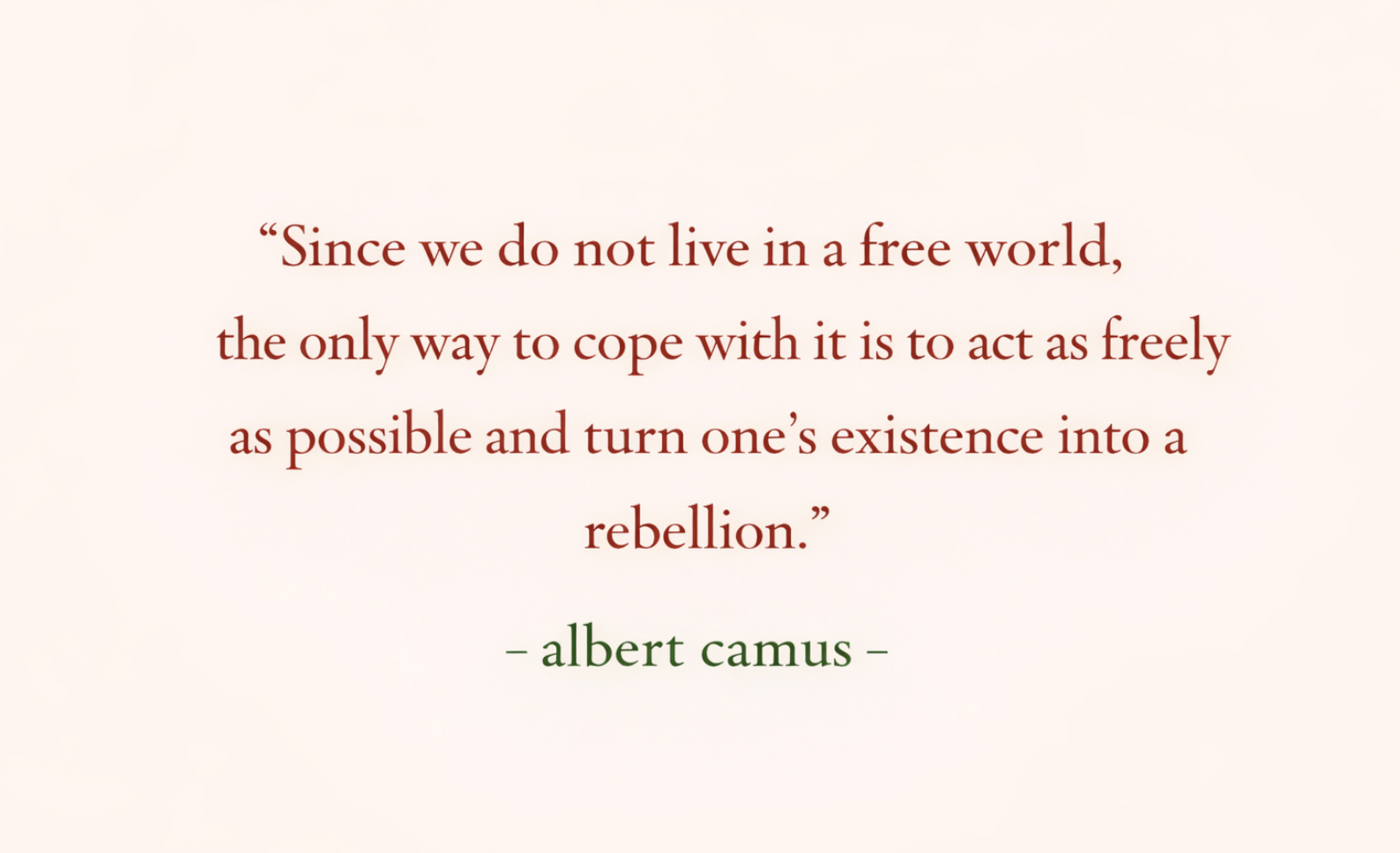
There is no universal solution. The absurd does not instruct; it exposes. What follows depends on one’s temperament, values, and courage. But one thing is constant: once the illusion of given meaning collapses, neutrality is no longer available. To live is already to have responded.
Un-ask the question. It is meaningless to ask some questions since there is no answer that we can come up with. Then un-ask it. Do not bother with it.
‘Why are people born? Why do they die? Why do they want to spend so much of the intervening time wearing digital watches?’ (The Hitchhiker’s Guide to the Galaxy , p. 119) – it is only to say that ultimately there is probably no reason for any of it. Adams’ conclusion that forty-two is the ‘answer’ to the question, ‘What is the meaning of life, the universe and everything?’, aims to illustrate that there is really no satisfactory answer and that the problem lies in the question itself. Un-ask the question, as the Buddhists say.
You need to strive for authenticity. Let go of the ego and self. Always flow, always be.
Authenticity is the holy grail of existentialism, the great existentialist aspiration or ideal. Very simply, authenticity involves continually living according to the realization that you are not a fixed entity like a rock or a table, defined entirely by circumstances, but a free being responsible for your choices. To live as though you are a fixed entity is what existentialist philosophers call bad faith.
We are in in constant process of becoming and change. We are free and responsible for every action or inaction.
None of us are fixed entities like tables or stones, but indeterminate, ambiguous beings in constant process of becoming and change. We are all free and can’t stop being free. We are all responsible for our actions and our lives are burdened with desire, guilt and anxiety, especially anxiety about what other people think of us. This leads us to suffer such bothersome emotions as guilt, shame and embarrassment. And, if all this isn’t terrible enough, we are doomed to die from the moment we are born into a meaningless universe where there is no God, or at least a very elusive one. Amazingly, despite this tale of woe, existentialism is ultimately a positive and optimistic philosophy.
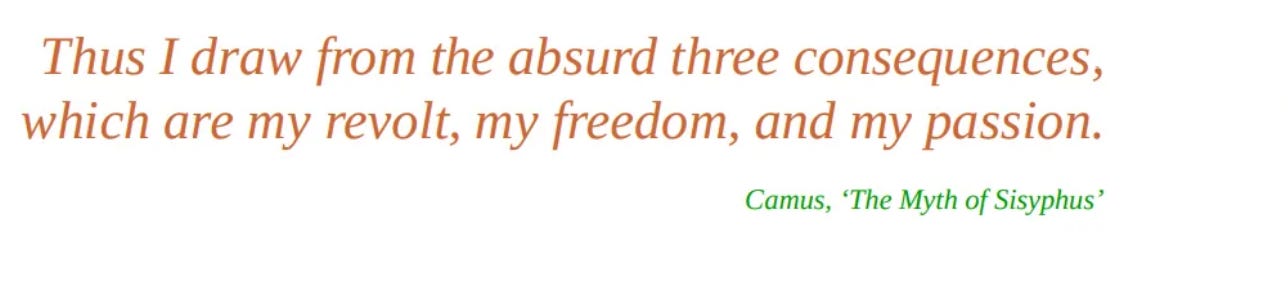
We need to think Sisyphus happy. Push the rock. Push the rock. Focus on the little picture. Not on the end.
Camus’ seemingly pessimistic account of the existential truths of the human condition yields an optimistic conclusion: although life’s struggle has no ultimate purpose and always the same end result, a person can still create a sense of purpose through the struggle itself and through the way she plays life’s game.
Some Kierkegaardian thoughts:
Kierkegaard believed that each individual must create their own path in life.
He argued that societal norms and values can be a form of self-deception.
Kierkegaard emphasized the importance of personal responsibility.
He believed that individuals must embrace the anxiety and uncertainty of existence.
Kierkegaard rejected the idea of organized religion.
He thought that religion could provide individuals with a framework for understanding existence.
Kierkegaard believed that faith was an important aspect of existence.
He emphasized the importance of subjective experience and personal choice.
Kierkegaard believed that the individual was the most important aspect of existence.
He thought that people often avoid responsibility by conforming to societal norms.
Kierkegaard believed that individuals must be willing to make choices in the face of uncertainty.
We people need the leap of faith since it is beyond our comprehension to fully grasp the reality.
He argued that the pursuit of truth was essential to existence.
Kierkegaard believed that human existence was marked by a sense of despair.
"Life can only be understood backwards; but it must be lived forwards."
"The most common form of despair is not being who you are."
"Anxiety is the dizziness of freedom."
"Once you label me you negate me."
"To dare is to lose one's footing momentarily. Not to dare is to lose oneself."
"Purity of heart is to will one thing."
"The function of prayer is not to influence God, but rather to change the nature of the one who prays."
"The greatest danger, that of losing one's own self, may pass off quietly as if it were nothing; every other loss, that of an arm, a leg, five dollars, a wife, etc., is sure to be noticed."
"Life is not a problem to be solved, but a reality to be experienced."
"The truth is a trap: you cannot get it without it getting you; you cannot get the truth by capturing it, only by its capturing you."
Some Terms:
The Project of Becoming an Individual
Existentialism begins with a task that is never formally assigned, yet cannot be refused. Each person is expected to become an individual, though no instructions are provided. One is judged not for failing to resemble others, but for failing to become oneself. Rabbi Zusya’s fear was not that he had not been Moses, but that he had not been Zusya. Kierkegaard calls this the risk of being oneself without reservation, a risk that offers no protection and no witnesses.
Subjectivity
In existential thought, experience does not wait to be verified. Kierkegaard insists that truth is not something one observes from a distance, but something one is entangled in. The attempt to reach an objective standpoint often results in forgetting that one exists at all. One steps back far enough to see everything clearly, and in doing so, loses oneself.
The Ideal of Objectivity
Kierkegaard treats absolute objectivity with suspicion. The colder and more neutral one becomes, the more one begins to resemble an external report on one’s own life. Existential questions, he argues, cannot be approached with detachment. They require involvement. Passion, not neutrality, is the price of understanding.
The Self
The self is not a substance, but a relation that relates to itself. It is not achieved by merely being different from others, but by sustaining this inward relation. The self is something that can fail, and often does.
Despair
Despair, for Kierkegaard, is the condition of refusing to be a self. It arises when the balance between necessity and possibility collapses. One either becomes trapped in what must be, or lost in what could be. In both cases, the relation to oneself breaks down.
Necessity
Necessity names everything about oneself that arrives without consultation. One’s body, temperament, past, and circumstances. Nietzsche suggests that the task is not to eliminate necessity, but to learn to see it as something that can be affirmed, even shaped into something bearable, perhaps even beautiful.
Freedom
Freedom appears as open possibility, as the ability to become otherwise. Sartre calls this a sentence rather than a privilege. We are condemned to freedom. De Beauvoir adds that freedom is never secured once and for all. It must be claimed repeatedly, under conditions that never fully cooperate.
Faith
For Kierkegaard, faith is the tension between infinite inner commitment and objective uncertainty. It is not certainty, but persistence. To give absolute value to something while knowing it cannot be proven.
Perspectivism
Nietzsche denies the existence of a view from nowhere. Every claim, every value, every philosophy emerges from a particular position, shaped by need and interest. Philosophies, he suggests, are confessions disguised as arguments.
Nihilism
Nihilism names the moment when the highest values lose their authority. The question “why?” receives no reply. Nietzsche treats this not as an endpoint, but as a passage. Values do not disappear forever. They must be understood as human creations before they can be re-created.
Self-Creation
Self-creation is not invention from nothing. It is the difficult work of arranging one’s strengths and weaknesses into a coherent form. Nietzsche describes it as giving style to one’s character. The past is not erased, but reinterpreted.
Eternal Recurrence
Nietzsche’s thought experiment asks whether one could affirm one’s life if it were to repeat endlessly, exactly as it is. It is not a prediction, but a test. How much of one’s life could one bear to live again.
Dasein
Heidegger names the human being Dasein, being-there. Not a thing among things, but the being for whom being itself is an issue. Dasein exists always already in a world, involved, entangled, unable to step fully outside.
Understanding of Being
Even ordinary speech carries an implicit understanding of being. To say that something is there already assumes a sense of what it means to be. Dasein cannot avoid this understanding. It lives inside it.
Everydayness and Inauthenticity
In daily life, Dasein tends to lose itself in routines, roles, and distractions. It drifts away from the question of its own existence. Inauthenticity is not a moral failure, but a condition of forgetting to take ownership of one’s being.
Anxiety
Anxiety interrupts this drift. It reveals finitude and groundlessness. In anxiety, familiar meanings loosen their grip, and Dasein confronts its own possibilities without cover.
Authenticity
Authenticity, for Heidegger, is not sincerity or self-expression. It is the decision to take responsibility for one’s being, to acknowledge finitude, and to stand resolutely toward the future. It means belonging to oneself.
Existence Precedes Essence
Sartre’s formula states that the human being exists first and defines itself afterward. There is no built-in nature to consult. What one is becomes visible only through what one does.
Responsibility
Because there is no predetermined essence, every choice carries weight beyond the individual. In choosing, one proposes an image of what a human being ought to be. Responsibility extends further than intended.
Bad Faith
Bad faith is the attempt to escape this burden. It appears when one pretends to be a fixed thing, or denies what one already is. It is not ignorance, but a practiced form of self-deception, carried out in full awareness.
What to take from all this:
The problem with existentialism is that understanding it does not make living it any easier. I can explain bad faith to you clearly, but I still catch myself performing roles, still feel the pull to hide behind circumstances, still manufacture reasons why now is not the time. The knowledge sits there like an unwelcome mirror. I see what I am doing, and I do it anyway. This is perhaps the most uncomfortable part of Sartre’s philosophy: it offers no technique for escape, no method that makes authenticity automatic. You do not graduate from bad faith. You notice it, resist it, fail, notice again. Freedom is not a state you achieve but a tension you maintain, day after day, in small decisions that no one else will ever see or validate. The weight does not get lighter. You only get more honest about what you are carrying.
According to David R. Cerbone, existentialism does not present itself as a doctrine with clear instructions. It operates more like a summons one that arrives without explanation and cannot be declined.
At its core is a concern with the individual, not as a specimen among others, but as this particular person. Not merely different in number, but singular in burden. Existentialism asks what it means to become who one is, without templates, without precedent, and without reassurance that such a task can ever be completed successfully.
One of the obstacles standing in the way of this becoming, Cerbone notes, is tradition itself. Inherited ways of thinking customs, assumptions, ready-made interpretations press in on the individual, offering comfort at the cost of authenticity. Existentialism seeks to loosen their grip, not because rebellion is noble, but because these assumptions quietly decide our lives for us if left unexamined.
Drawing on Jean-Paul Sartre, Cerbone emphasizes that the human being is an self-interpreting creature. We are not given a definition at birth. We arrive, find ourselves already involved, and only afterward attempt to say what we are. Freedom, in this sense, is not a gift but a condition one inseparable from anxiety, anguish, and despair. Existentialism does not aim to remove these states, but to understand what they reveal.
With Friedrich Nietzsche in the background, Cerbone describes existentialism as a project of self-creation. Not invention from nothing, but a difficult and often uncomfortable assessment of one’s strengths and limitations. The task is to give oneself a kind of form to impose a “style” on one’s character knowing that there is no external judge to certify the result.
Turning to Martin Heidegger, Cerbone places at the center of existentialism the distinctive nature of human existence itself. Through the idea of Dasein, the human being appears as the one entity for whom being is a question. We do not merely exist; we are concerned with our existence, troubled by it, responsible for how it unfolds.
Taken together, Cerbone suggests that existentialism is less a philosophy of answers than of exposure. Its aim is not to tell us who we are, but to make it impossible to avoid the task of becoming without guarantees, without excuses, and without the comfort of a predetermined essence.
And remember:
Existence precedes essence.
“Existence precedes essence.”
Jean-Paul SartreAccept the burden of freedom.
“Man is condemned to be free; because once thrown into the world, he is responsible for everything he does.”
Jean-Paul SartreConfront the absurd.
“The absurd lies in the juxtaposition between the fundamental human need to attribute meaning to life and the unreasonable silence of the universe.”
Albert CamusImagine Sisyphus happy.
“The struggle itself toward the heights is enough to fill a man’s heart. One must imagine Sisyphus happy.”
Albert CamusQuestion social roles.
“One is not born, but rather becomes, a woman.”
Simone de BeauvoirAffirm transparent freedom.
“I wish that every human life might be pure, transparent freedom.”
Simone de BeauvoirSee anxiety as the vertigo of freedom.
“Anxiety is the dizziness of freedom.”
Søren KierkegaardUnderstand life backward, live it forward.
“Life can only be understood backwards; but it must be lived forwards.”
Søren KierkegaardRecognize that freedom implies responsibility.
“Freedom is only part of the story and half of the truth; its positive aspect is responsibility.”
Viktor FranklRecreate values.
“God is dead. God remains dead.”
Friedrich NietzscheBecome who you are.
“You shall become the person you are.”
Friedrich NietzscheBe cautious when staring into the abyss.
“He who fights with monsters should be careful lest he thereby become a monster. And if you gaze long into an abyss, the abyss also gazes into you.”
Friedrich NietzscheLove your fate, amor fati.
“My formula for greatness in a human being is amor fati, that one wants nothing to be different, not forward, not backward, not in all eternity, but love it.”
Friedrich NietzscheLive with an authentic awareness of death.
“Authentic being-toward-death calls Dasein’s individual self out of its they-self.”
Martin HeideggerAccept your thrownness into the world.
“Thrownness denotes the arbitrary character of existence, the fact that we find ourselves born into a world we did not choose.”
Martin HeideggerLive with bodily awareness.
“The body is our general medium for having a world.”
Maurice Merleau-PontySee the other as a ‘Thou,’ not an object.
“All real living is meeting.”
Martin BuberAvoid bad faith.
“Bad faith is the lie of a consciousness to itself.”
Jean-Paul SartreWill freedom for both yourself and others.
“To will oneself free is also to will others free.”
Simone de BeauvoirLive courageously.
“The secret of reaping the greatest fruitfulness and the greatest enjoyment from life is to live dangerously.”
Friedrich Nietzsche
If existentialism has any practical value, it is not that it teaches optimism. It teaches exposure. It removes the comfortable fiction that a meaningful life is one that feels meaningful from the inside. Meaning is not a mood; it is a consequence. The question is not whether I can explain my life, but whether I can stand behind it. Sartre does not promise peace. He offers something harsher: the chance to stop living as a spectator of your own days. Not because the universe will reward you, but because there is no one else to do your living for you.
Even now, writing this, I feel the familiar paralysis creeping back. Is this essay good enough? Should I wait to publish it until I understand more? The irony is not lost on me - I am hesitating over an essay about hesitation. But perhaps that is the point. Sartre does not promise that understanding existentialism will cure you of being human. He promises something harder: that you will see clearly what you are doing when you hesitate, when you hide, when you perform. And seeing clearly, you will have to choose whether to continue. Not once, but every time. The three o’clock feeling never fully disappears. But at least now, when it arrives, I recognize it for what it is: not a truth about timing, but a question about courage. And questions, unlike truths, demand answers. Even imperfect ones. Even now.
I thank the books below for teaching me how to live like an existentialist.
!["[(Existentialism : A Beginner's Guide)] [By (author) Thomas E. Wartenberg] published on (September, 2008)"](https://substackcdn.com/image/fetch/$s_!nVX2!,f_auto,q_auto:good,fl_progressive:steep/https%3A%2F%2Fsubstack-post-media.s3.amazonaws.com%2Fpublic%2Fimages%2F6cec7d46-8715-41c8-8d86-686ebdafc640_326x500.jpeg ""[(Existentialism : A Beginner's Guide)] [By (author) Thomas E. Wartenberg] published on (September, 2008)"")